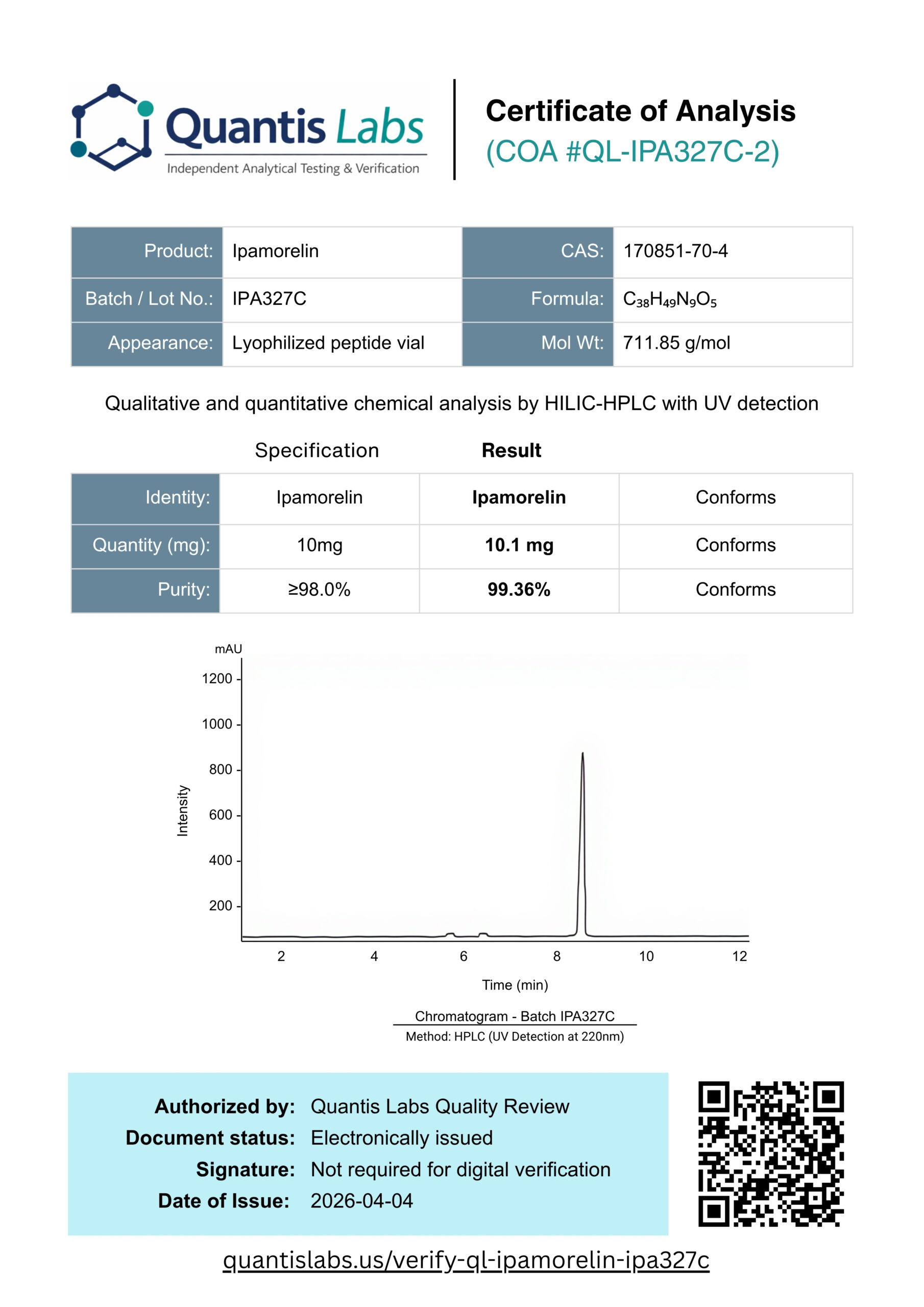
Ipamorelin in Vietnam
Ipamorelin is a growth-hormone secretagogue commonly researched for growth-hormone pulse signaling, recovery, sleep, body composition, and age-related hormone pathway models.
Unlike direct HGH, Ipamorelin does not add growth hormone from the outside. It is researched for its ability to signal the pituitary to release more of its own growth hormone. Think of HGH as bringing bottled water. Ipamorelin is more like turning on the faucet.
Why researchers are interested in Ipamorelin
Ipamorelin is widely discussed because it may stimulate growth-hormone release while being more selective than older growth-hormone secretagogues. Researchers are especially interested in its relationship to GH pulses, recovery, sleep, and body-composition biology.
GH pulse research
Ipamorelin is studied for its ability to stimulate pulse-style growth-hormone release through the ghrelin receptor pathway.
Recovery models
Growth-hormone signaling is connected to tissue repair, sleep quality, collagen turnover, and recovery biology.
Selective signaling
Ipamorelin is often discussed as a more selective secretagogue compared with some older peptides that may affect cortisol or prolactin more strongly.
Common Ipamorelin research formats in Vietnam
Pricing below is listed as Vietnam reference pricing for research-use formats. Availability, batch verification, and sourcing may vary.
Ipamorelin
BAC Water
Common Ipamorelin research-dose discussions
Ipamorelin is commonly discussed in microgram ranges, often in sleep, recovery, and growth-hormone pulse research contexts. These examples are research-community discussions only.
| Research Focus | Commonly Discussed Range | Notes |
|---|---|---|
| Conservative pulse research | 100-200mcg daily | Often discussed in introductory GH-pulse research. |
| Recovery and sleep research | 200-300mcg daily | Frequently discussed around evening or pre-sleep models. |
| Higher-dose discussions | 300-500mcg daily | More aggressive research discussions. Not something to treat casually. |
Ipamorelin calculations with 2mL or 3mL BAC water
These examples use a standard U100 insulin syringe where 100 units equals 1mL. For a 10mg vial, 2mL and 3mL are practical options that make small doses easier to measure.
10mg vial + 2mL BAC water
| Dose | Units | Approx. Vial Duration |
|---|---|---|
| 100mcg | 2 units | 100 doses |
| 200mcg | 4 units | 50 doses |
| 300mcg | 6 units | 33 doses |
| 500mcg | 10 units | 20 doses |
10mg vial + 3mL BAC water
| Dose | Units | Approx. Vial Duration |
|---|---|---|
| 100mcg | 3 units | 100 doses |
| 200mcg | 6 units | 50 doses |
| 300mcg | 9 units | 33 doses |
| 500mcg | 15 units | 20 doses |
2mL or 3mL?
Both are practical. 2mL keeps the injection volume smaller, while 3mL gives slightly larger syringe measurements for smaller doses. If the target amount is 100-200mcg, 3mL may be easier to see. If the target is 300-500mcg, 2mL is usually simple enough.
Need different calculations?
Use the PepsVN peptide calculator to calculate any vial size, BAC water amount, dose, or syringe-unit measurement.
What researchers often discuss alongside Ipamorelin
Ipamorelin is often discussed with other recovery, growth-hormone-axis, and body-composition research compounds.
Ipamorelin + CJC-1295
This is the classic growth-hormone secretagogue pairing. CJC-1295 supports the GHRH side of the signal, while Ipamorelin supports the ghrelin-receptor side.
Ipamorelin + BPC-157
BPC-157 is commonly discussed for tissue-repair models, while Ipamorelin is discussed for recovery and growth-hormone pulse research.
Ipamorelin + GHK-Cu
GHK-Cu is often discussed for collagen, skin, and tissue remodeling, making it a common companion in repair-focused research stacks.
CJC-1295 + Ipamorelin
Growth-hormone pulse blend commonly discussed in recovery research.
BPC-157 in Vietnam
Commonly discussed in tissue-repair and recovery research.
GHK-Cu in Vietnam
Often discussed for collagen, skin, and tissue-remodeling research.
HGH in Vietnam
Direct growth hormone research often compared with secretagogues.
How Ipamorelin is believed to work
Ipamorelin is best understood as a growth-hormone secretagogue. That means researchers study it for its ability to encourage the body to release more of its own growth hormone, rather than adding HGH directly from the outside.
What is a secretagogue?
A secretagogue is a compound that stimulates the body to secrete something. In this case, Ipamorelin is researched for stimulating growth-hormone release.
It is less like pouring growth hormone into the system and more like sending a signal to the pituitary gland: “Hey, release a pulse.” Politely, of course.
The ghrelin receptor pathway
Ipamorelin acts through the growth hormone secretagogue receptor, also known as the ghrelin receptor.
Ghrelin is often called the hunger hormone, but this receptor system also plays a role in growth-hormone release. Biology loves giving one system multiple jobs just to keep everyone humble.
Why selectivity matters
Older growth-hormone secretagogues may also influence cortisol or prolactin more strongly.
Ipamorelin is often discussed as more selective, meaning researchers are interested in whether it can stimulate GH release with less unwanted signaling noise.
Pulse-style GH release
Natural growth hormone is released in pulses, especially during deep sleep.
Ipamorelin is studied for supporting pulse-style GH release rather than producing constant exposure. That pulse pattern matters because hormones are not just about how much; timing also matters.
Why sleep gets discussed
Growth-hormone pulses are closely connected to sleep, especially deep sleep.
This is why Ipamorelin is often discussed in evening or pre-sleep research models. Growth hormone and sleep are close friends. Unfortunately, caffeine and midnight scrolling are not invited.
Why recovery gets discussed
Growth-hormone signaling is connected to collagen turnover, tissue repair, body composition, and metabolic regulation.
Ipamorelin is not a magic recovery switch. It is researched because growth-hormone signaling is one part of a larger repair and recovery system.
What researchers actually know so far
Ipamorelin remains a research peptide and is not approved as a medical treatment for human use.
It is widely discussed in research communities because of its relationship to growth-hormone pulse signaling, recovery models, sleep-related hormone rhythms, and body-composition pathways.
The science is interesting, but it should be treated as experimental. Anyone presenting it like a guaranteed shortcut is probably selling the shortcut more than the science.
All products and information referenced on this page are intended strictly for research purposes only. Ipamorelin is a research peptide and is not presented as a medical treatment. Nothing on this page is medical advice, diagnosis, treatment guidance, or a recommendation for human or animal use. The purchase, possession, sale, or use of research compounds may be restricted or illegal in some jurisdictions. Readers are responsible for complying with local laws and regulations.