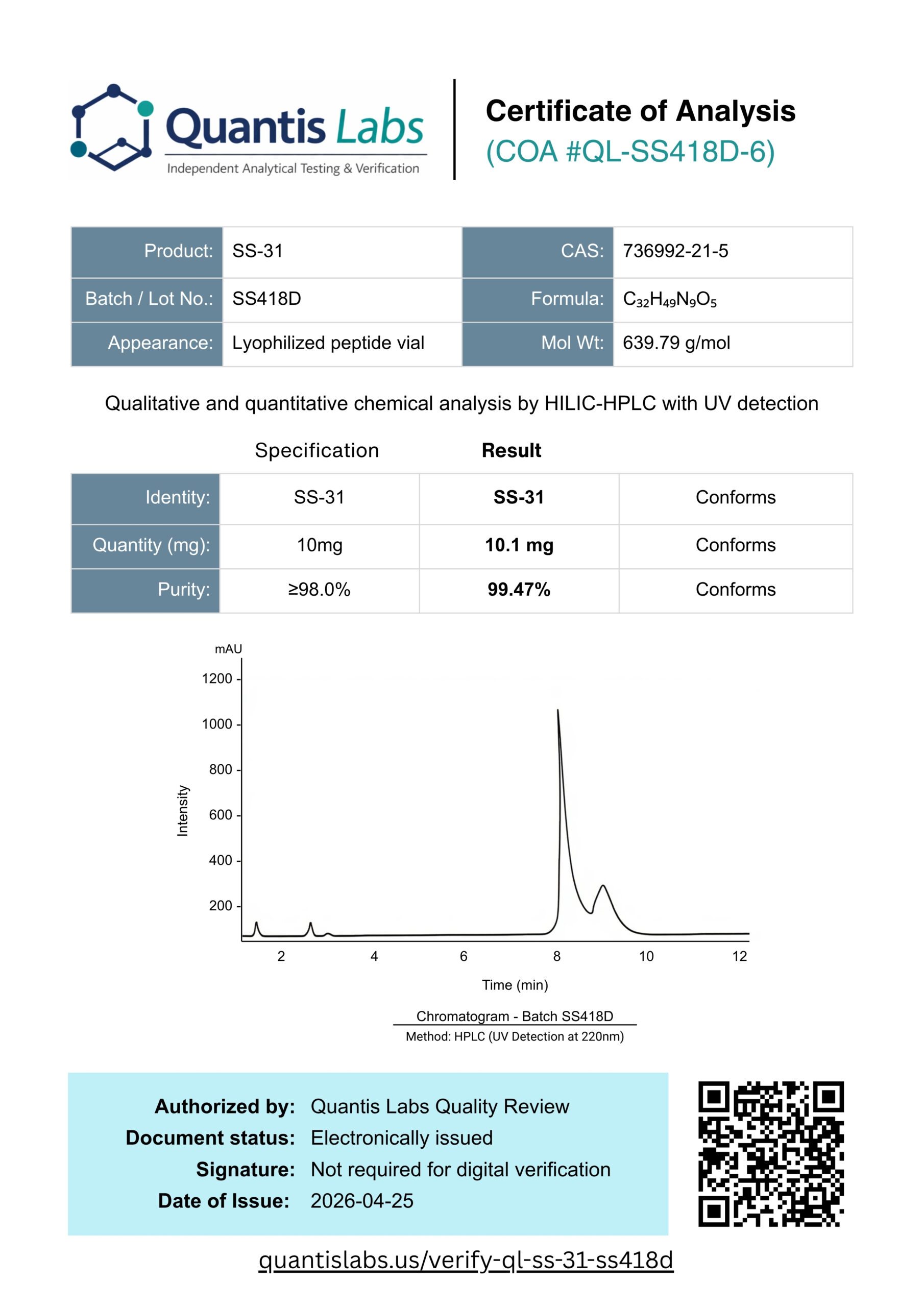
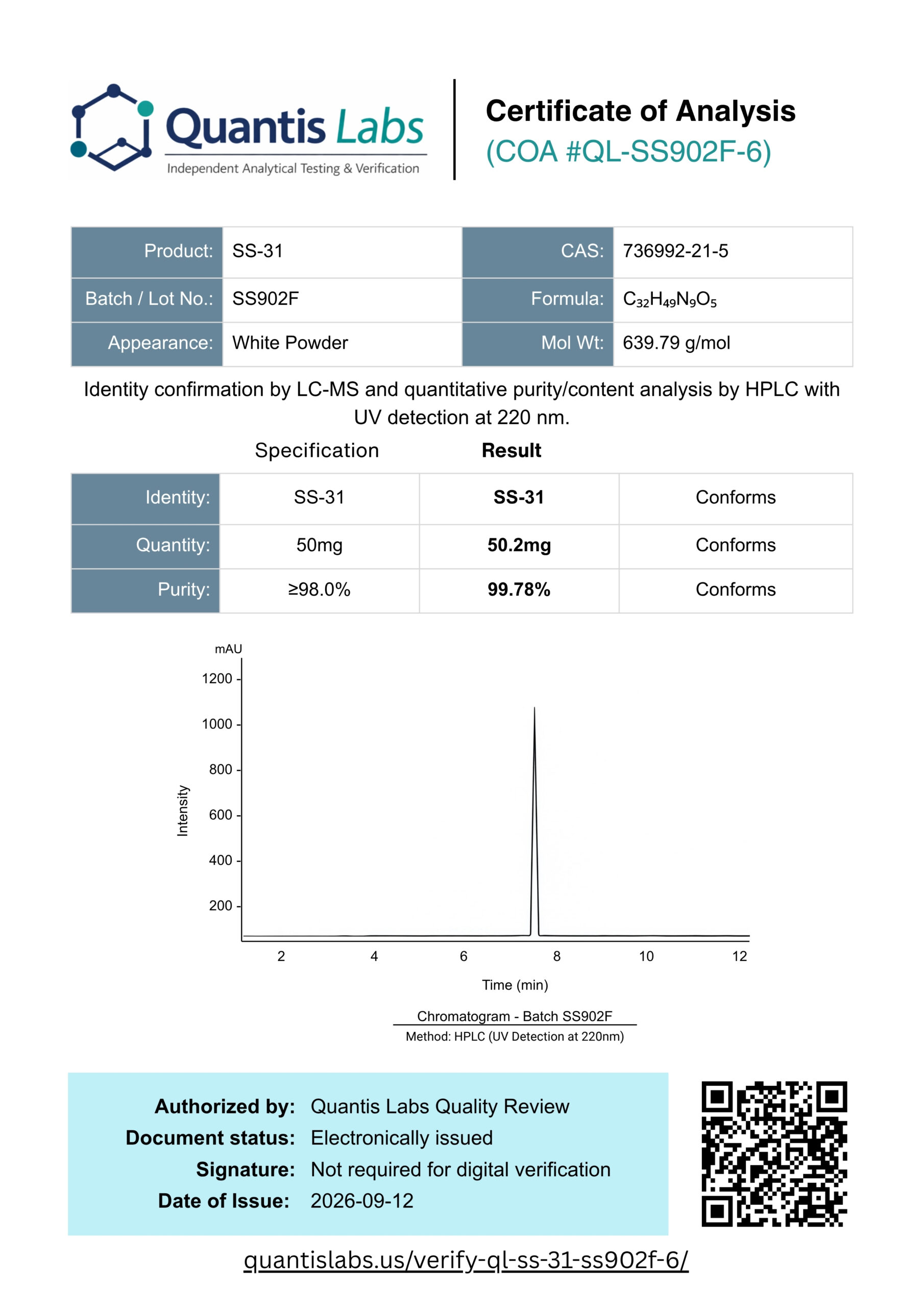
SS-31 • Elamipretide • Vietnam • Research information

SS-31 in Vietnam

SS-31, also known as Elamipretide, is a mitochondrial-targeting peptide commonly researched for mitochondrial function, oxidative stress, cellular energy, muscle performance, recovery, and healthy-aging pathways.

Most “energy” compounds talk vaguely about feeling better. SS-31 is more specific: researchers are interested in how it interacts with the inner mitochondrial membrane, where cells actually make usable energy. Basically, it goes closer to the power plant instead of yelling motivational quotes from outside the building.

01
Commonly researched for mitochondrial membrane support and cellular energy.
02
Frequently discussed in oxidative-stress, endurance, recovery, and aging research.
03
Available as 10mg and 50mg research formats.
SS-31 Elamipretide peptide vial
Scan to view COA
SS-31 Elamipretide COA QR code
Research Overview

Why researchers are interested in SS-31

SS-31 is studied because it targets mitochondria, especially the inner mitochondrial membrane. Researchers are interested in how this may influence oxidative stress, ATP production, mitochondrial efficiency, and cellular stress responses.

01

Mitochondrial targeting

SS-31 is commonly discussed because it appears to concentrate near the inner mitochondrial membrane, where energy production happens.

02

Oxidative stress research

Mitochondria produce energy, but they also generate reactive oxygen species. SS-31 is researched for its relationship to oxidative-stress control.

03

Energy and recovery

Because mitochondria drive cellular energy production, SS-31 is often discussed in endurance, recovery, fatigue, and healthy-aging research.

Reference Pricing

Common SS-31 research formats in Vietnam

Pricing below is listed as Vietnam reference pricing for research-use formats. Availability, batch verification, and sourcing may vary.

SS-31

10mg vial
$30 750,000₫

SS-31

50mg vial
$80 2,000,000₫

BAC Water

10mL vial
$5 125,000₫
Common Research Protocols

Common SS-31 research-dose discussions

SS-31 is commonly discussed in milligram ranges. Research conversations often focus on mitochondrial function, oxidative stress, energy output, endurance, and recovery models.

Research Focus Commonly Discussed Range Notes
Conservative mitochondrial research 1-2mg Often discussed as a lower research range.
Energy and recovery research 2-5mg Frequently discussed in fatigue, recovery, and performance models.
Higher-dose discussions 5-10mg More aggressive research discussions. Usually seen in advanced mitochondrial protocols.
These examples represent research-community discussions only and should not be interpreted as medical guidance.
Reconstitution Examples

SS-31 calculations with BAC water

These examples use a standard U100 insulin syringe where 100 units equals 1mL. The 10mg vial works well with 1mL or 2mL, while the 50mg vial is usually more practical with 2mL or 3mL.

10mg vial + 1mL BAC water

Dose Units Approx. Vial Duration
1mg10 units10 doses
2mg20 units5 doses
5mg50 units2 doses
10mg100 units1 dose
With 1mL added to a 10mg vial, each unit equals 100mcg.

10mg vial + 2mL BAC water

Dose Units Approx. Vial Duration
1mg20 units10 doses
2mg40 units5 doses
5mg100 units2 doses
10mg200 units / 2mL1 dose
With 2mL added to a 10mg vial, each unit equals 50mcg.

50mg vial + 2mL BAC water

Dose Units Approx. Vial Duration
1mg4 units50 doses
2mg8 units25 doses
5mg20 units10 doses
10mg40 units5 doses
With 2mL added to a 50mg vial, each unit equals 250mcg.

50mg vial + 3mL BAC water

Dose Units Approx. Vial Duration
1mg6 units50 doses
2mg12 units25 doses
5mg30 units10 doses
10mg60 units5 doses
With 3mL added to a 50mg vial, each unit equals approximately 167mcg.

10mg or 50mg?

The 10mg vial is simpler for lower research amounts and shorter protocols. The 50mg vial is more practical for repeated milligram-range research because the vial lasts longer and the syringe measurements stay manageable.

Need different calculations?

Use the PepsVN peptide calculator to calculate any vial size, BAC water amount, dose, or syringe-unit measurement.

Mitochondrial Research

Why SS-31 is often discussed for mitochondrial health

SS-31 is different from general antioxidant compounds because it is discussed for targeting mitochondria more directly. That makes it especially interesting in energy, aging, muscle, heart, and recovery research.

The inner mitochondrial membrane

The inner mitochondrial membrane is where much of ATP production happens. It is basically the cell’s energy-production machinery.

SS-31 is researched because it appears to interact with this area, especially with mitochondrial membrane structures involved in energy production.

Cardiolipin research

Cardiolipin is a special lipid found in the inner mitochondrial membrane.

Researchers discuss SS-31 because it may help stabilize cardiolipin and support mitochondrial membrane function. Not exactly dinner conversation, but very important if you care about cellular energy.

Oxidative stress

Mitochondria naturally produce reactive oxygen species during energy production.

Too much oxidative stress can damage mitochondrial proteins, membranes, and DNA. SS-31 is often discussed for its possible role in reducing mitochondrial oxidative stress.

Energy efficiency

When mitochondria function better, cells may produce energy more efficiently.

That is why SS-31 appears in research conversations around fatigue, endurance, muscle function, recovery, and age-related energy decline.

Common Stacks

What researchers often discuss alongside SS-31

SS-31 is commonly discussed with compounds that focus on mitochondrial health, cellular energy, metabolism, and oxidative-stress pathways.

SS-31 + MOTS-c

MOTS-c is discussed for mitochondrial signaling and metabolic flexibility, while SS-31 is discussed for mitochondrial membrane and oxidative-stress research.

SS-31 + NAD+

NAD+ is central to cellular energy production, making it a common research companion to SS-31 in mitochondrial and healthy-aging discussions.

SS-31 + Glutathione

Glutathione is discussed for antioxidant defense, while SS-31 is more specifically discussed for mitochondrial oxidative-stress research.

Mechanism

How SS-31 is believed to work

SS-31 is best understood as a mitochondrial-targeting peptide. Instead of working broadly across the whole body in a vague “energy support” way, researchers are interested in its specific relationship with mitochondrial membranes and oxidative stress.

Targets mitochondria

SS-31 is designed to concentrate in mitochondria, especially near the inner mitochondrial membrane.

That matters because mitochondria are where cells convert nutrients into ATP, the usable energy currency of the cell.

Supports membrane stability

Mitochondrial membranes need to stay organized for energy production to work properly.

SS-31 is researched for its possible relationship with cardiolipin, a key mitochondrial membrane lipid involved in energy production.

Reduces oxidative stress

Energy production naturally creates oxidative byproducts.

SS-31 is discussed because it may help reduce oxidative damage near the place where many of those byproducts are produced. That is more targeted than throwing a generic antioxidant into the system and hoping it finds the right room.

ATP production

ATP is the energy molecule cells use to power almost everything.

Researchers study SS-31 because better mitochondrial membrane function may support more efficient ATP production, especially in stressed or aging cells.

Muscle and endurance research

Muscle tissue has high energy demand, which makes mitochondrial function especially important.

This is why SS-31 appears in research conversations around exercise performance, fatigue resistance, recovery, and age-related muscle decline.

Healthy-aging research

Mitochondrial dysfunction is one of the major topics in aging research.

SS-31 is discussed because it targets a part of the cell that tends to become less efficient with age. Not a magic anti-aging switch, but definitely an interesting research pathway.

Research Status

What researchers actually know so far

SS-31 / Elamipretide remains a research compound and is not presented here as a medical treatment.

It is widely discussed because of its relationship to mitochondrial membrane function, cardiolipin interaction, oxidative-stress reduction, ATP production, muscle function, and healthy-aging research.

The research is genuinely interesting, but mitochondrial biology is complicated. Anyone pretending it is just “more energy in a vial” is skipping the important parts.

Disclaimer:

All products and information referenced on this page are intended strictly for research purposes only. SS-31 / Elamipretide is a research peptide and is not presented as a medical treatment, mitochondrial disease treatment, anti-aging treatment, performance-enhancement product, or therapeutic recommendation. Nothing on this page is medical advice, diagnosis, treatment guidance, or a recommendation for human or animal use. The purchase, possession, sale, or use of research compounds may be restricted or illegal in some jurisdictions. Readers are responsible for complying with local laws and regulations.