BPC-157 + TB-500 Blend in Vietnam | PepsVN
BPC-157 + TB-500 • Vietnam • Research information

BPC-157 + TB-500 Blend in Vietnam

BPC-157 + TB-500 is a recovery-focused research blend commonly discussed for tissue repair, tendon and ligament models, cell migration, inflammation signaling, and soft-tissue remodeling.

These two peptides are often paired because they approach repair biology from different angles. BPC-157 is usually discussed as a repair-signaling peptide, while TB-500 is discussed more around cell movement and tissue remodeling.

01
Combines two of the most commonly discussed recovery peptides.
02
BPC-157 is often discussed for repair signaling and tissue-support models.
03
TB-500 is commonly discussed for cell migration, actin, and tissue remodeling.
BPC-157 TB-500 blend peptide vial
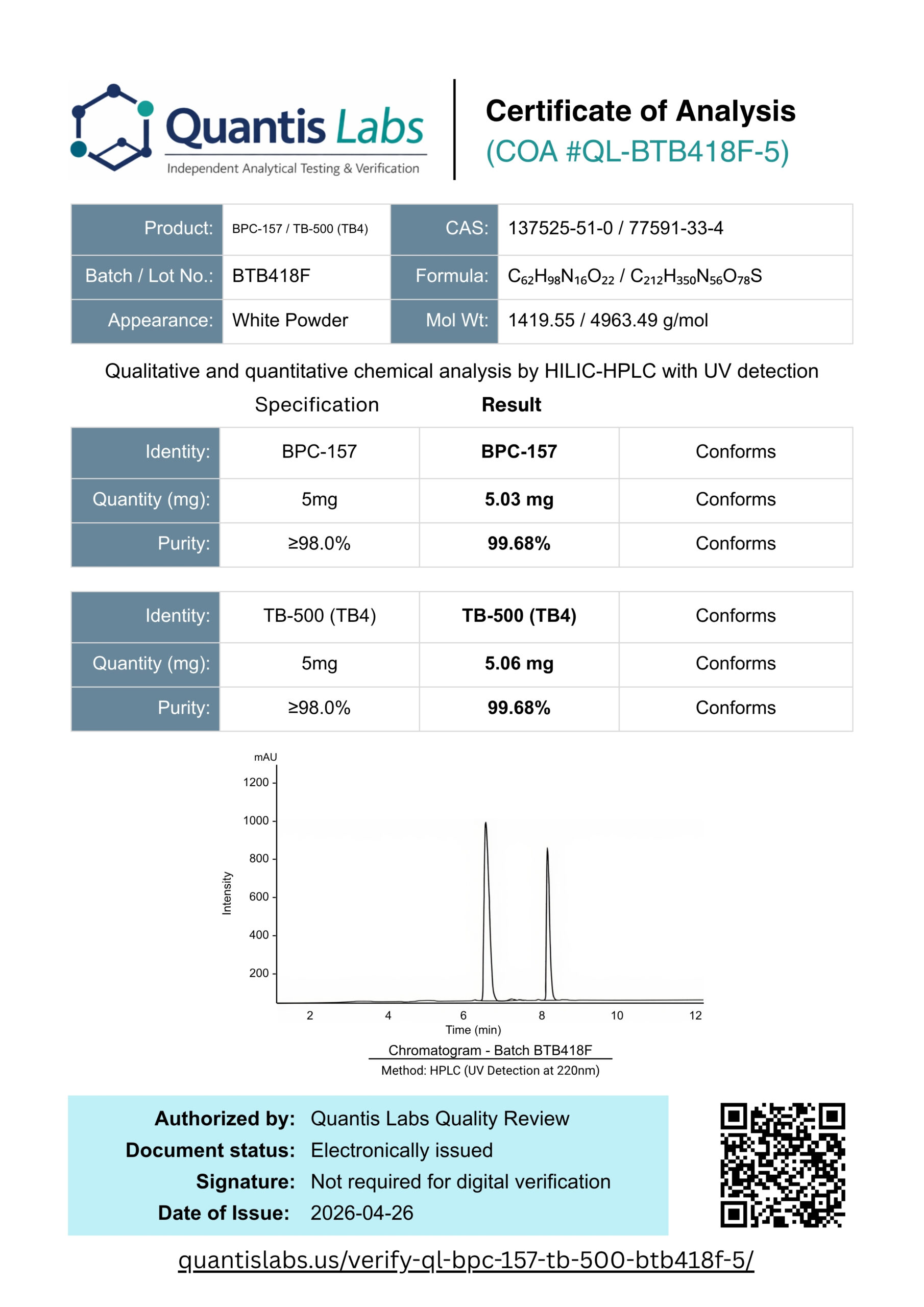
Scan to view COA
BPC-157 TB-500 blend COA QR code
Research Overview

Why researchers are interested in the BPC-157 + TB-500 blend

BPC-157 and TB-500 are frequently discussed together because recovery is not controlled by one simple switch. Tissue repair involves signaling, inflammation balance, blood-flow support, cell movement, and remodeling. This blend is built around that broader repair conversation.

01

Repair signaling

BPC-157 is often discussed in tendon, ligament, muscle, gut, and soft-tissue repair models.

02

Cell migration

TB-500 is commonly discussed for cell movement, actin regulation, and remodeling pathways.

03

Complementary pathways

Researchers often pair them because BPC-157 and TB-500 appear in similar recovery discussions while working through different mechanisms.

Formula Breakdown

What is in the BPC-157 + TB-500 blend?

This blend contains two recovery-focused research peptides in one vial.

Ingredient Amount Primary Research Interest
BPC-157 5mg Tissue repair, tendon/ligament models, gut research, recovery signaling
TB-500 5mg Cell migration, actin regulation, tissue remodeling, recovery models
Total blend amount: 10mg per vial. Each 1mg of total blend contains approximately 500mcg BPC-157 and 500mcg TB-500.
Reference Pricing

Common BPC-157 + TB-500 research format in Vietnam

Pricing below is listed as Vietnam reference pricing for research-use formats. Availability, batch verification, and sourcing may vary.

BPC-157 + TB-500 Blend

10mg vial
$37 925,000₫

BAC Water

10mL vial
$5 125,000₫
Common Research Protocols

Common BPC-157 + TB-500 blend research-dose discussions

This blend is usually discussed in total blend amounts. Because the blend is evenly split, each total blend dose contains half BPC-157 and half TB-500.

Total Blend Dose Approx. BPC-157 Approx. TB-500
500mcg 250mcg 250mcg
1mg 500mcg 500mcg
2mg 1mg 1mg
5mg 2.5mg 2.5mg
These examples are for calculation reference only and should not be interpreted as medical guidance or human-use instructions.
BPC-157 vs TB-500

Why these two peptides are often combined

BPC-157 and TB-500 are often mentioned in the same conversation, but they are not duplicates. They are discussed for different parts of repair biology.

BPC-157 TB-500
Often discussed for localized repair signaling Often discussed for cell migration and tissue remodeling
Common in tendon, ligament, gut, and soft-tissue research Common in actin, cell movement, and systemic recovery discussions
Research often focuses on healing signals and vascular-support pathways Research often focuses on movement, organization, and remodeling
Frequently paired with TB-500 Frequently paired with BPC-157
Simple version: BPC-157 is often discussed as helping send the repair signal. TB-500 is often discussed as helping the repair crew move and remodel tissue.
Reconstitution Examples

BPC-157 + TB-500 calculations with 1mL or 2mL BAC water

These examples use a standard U100 insulin syringe where 100 units equals 1mL. For a 10mg total blend, 1mL and 2mL both give practical calculations.

10mg vial + 1mL BAC water

Total Blend Dose Units Approx. Vial Duration
500mcg5 units20 doses
1mg10 units10 doses
2mg20 units5 doses
5mg50 units2 doses
With 1mL added to a 10mg blend vial, each unit equals 100mcg total blend.

10mg vial + 2mL BAC water

Total Blend Dose Units Approx. Vial Duration
500mcg10 units20 doses
1mg20 units10 doses
2mg40 units5 doses
5mg100 units2 doses
With 2mL added to a 10mg blend vial, each unit equals 50mcg total blend.

1mL or 2mL?

For this blend, 1mL gives smaller injection volume and very clean math. 2mL gives larger syringe-unit measurements, which some researchers prefer for smaller total blend amounts.

Need different calculations?

Use the PepsVN peptide calculator to calculate any vial size, BAC water amount, dose, or syringe-unit measurement.

Mechanism

How BPC-157 + TB-500 is believed to work

The blend is best understood as a two-part recovery research model. BPC-157 is commonly discussed for repair signaling, while TB-500 is commonly discussed for cell migration and tissue remodeling.

BPC-157: repair signaling

BPC-157 is often discussed in relation to tendon, ligament, muscle, gut, and soft-tissue repair models.

Researchers are interested in its relationship to angiogenesis, growth-factor signaling, nitric oxide pathways, and tissue-protection models.

TB-500: cell migration

TB-500 is commonly discussed in relation to thymosin beta-4 research, actin regulation, and cell movement.

Cell migration matters because repair is not just about sending a signal. Cells need to move into the right place and help rebuild structure.

Actin and tissue remodeling

Actin is a structural protein that helps cells move and change shape.

TB-500 is often discussed because thymosin beta-4-related pathways may influence actin dynamics, which is important in remodeling and wound-healing models.

Blood-flow and repair models

BPC-157 is frequently discussed in relation to vascular-support pathways and tissue-repair signaling.

Better repair usually requires more than one thing: signaling, circulation, controlled inflammation, and organized remodeling.

Inflammation balance

Inflammation is part of repair, but too much inflammation for too long can interfere with recovery.

Both BPC-157 and TB-500 appear in inflammation-related research discussions, though they are not usually described as working through the same exact mechanisms.

Why researchers like the pairing

The pairing makes sense because one compound is often discussed for repair signaling and the other for movement and remodeling.

Basically, BPC-157 helps send the repair memo, and TB-500 helps the crew get organized. Biology is more complicated than that, but the analogy works.

Related Research

What researchers often compare with this blend

Since this blend already combines two common recovery peptides, it is often compared with individual BPC-157, individual TB-500, or broader recovery formulas.

Blend vs BPC-157 alone

BPC-157 alone is usually more focused on repair signaling. The blend adds TB-500 for cell migration and remodeling discussions.

Blend vs TB-500 alone

TB-500 alone is usually more focused on cell movement and remodeling. The blend adds BPC-157 for tissue-repair signaling discussions.

Blend vs KLOW

KLOW adds GHK-Cu and KPV, making it more collagen, skin, and inflammation-pathway focused than the basic BPC/TB blend.

Research Status

What researchers actually know so far

BPC-157 + TB-500 blend remains a research-use peptide blend and is not presented here as a medical treatment.

Its individual components are widely discussed in research communities for tissue repair, soft-tissue recovery, cell migration, actin regulation, wound-healing models, inflammation signaling, and tissue remodeling.

The blend concept is interesting because repair biology involves multiple overlapping systems. That does not make it magic. It just makes it worth studying carefully.

Disclaimer:

All products and information referenced on this page are intended strictly for research purposes only. BPC-157 + TB-500 blend is a research peptide blend and is not presented as a medical treatment, injury treatment, wound-healing treatment, recovery treatment, or therapeutic recommendation. Nothing on this page is medical advice, diagnosis, treatment guidance, dosage guidance, injection instruction, or a recommendation for human or animal use. The purchase, possession, sale, or use of research compounds may be restricted or illegal in some jurisdictions. Readers are responsible for complying with local laws and regulations.