NAD+ • Vietnam • Research information

NAD+ in Vietnam

NAD+ (Nicotinamide Adenine Dinucleotide) is a naturally occurring coenzyme found in every living cell. It is commonly researched for cellular energy production, mitochondrial function, metabolism, DNA repair, cognitive function, and healthy-aging pathways.

Unlike most compounds on this website, NAD+ is not actually a peptide. It is a coenzyme. Researchers are interested in it because without NAD+, many of the body's energy-producing processes would simply stop working. Your cells treat NAD+ the way your phone treats electricity. Things get weird when it runs low.

01
Commonly researched for cellular energy production and metabolism.
02
Frequently discussed in mitochondrial and healthy-aging research.
03
Available as 500mg and 1000mg research formats.
NAD+ vial
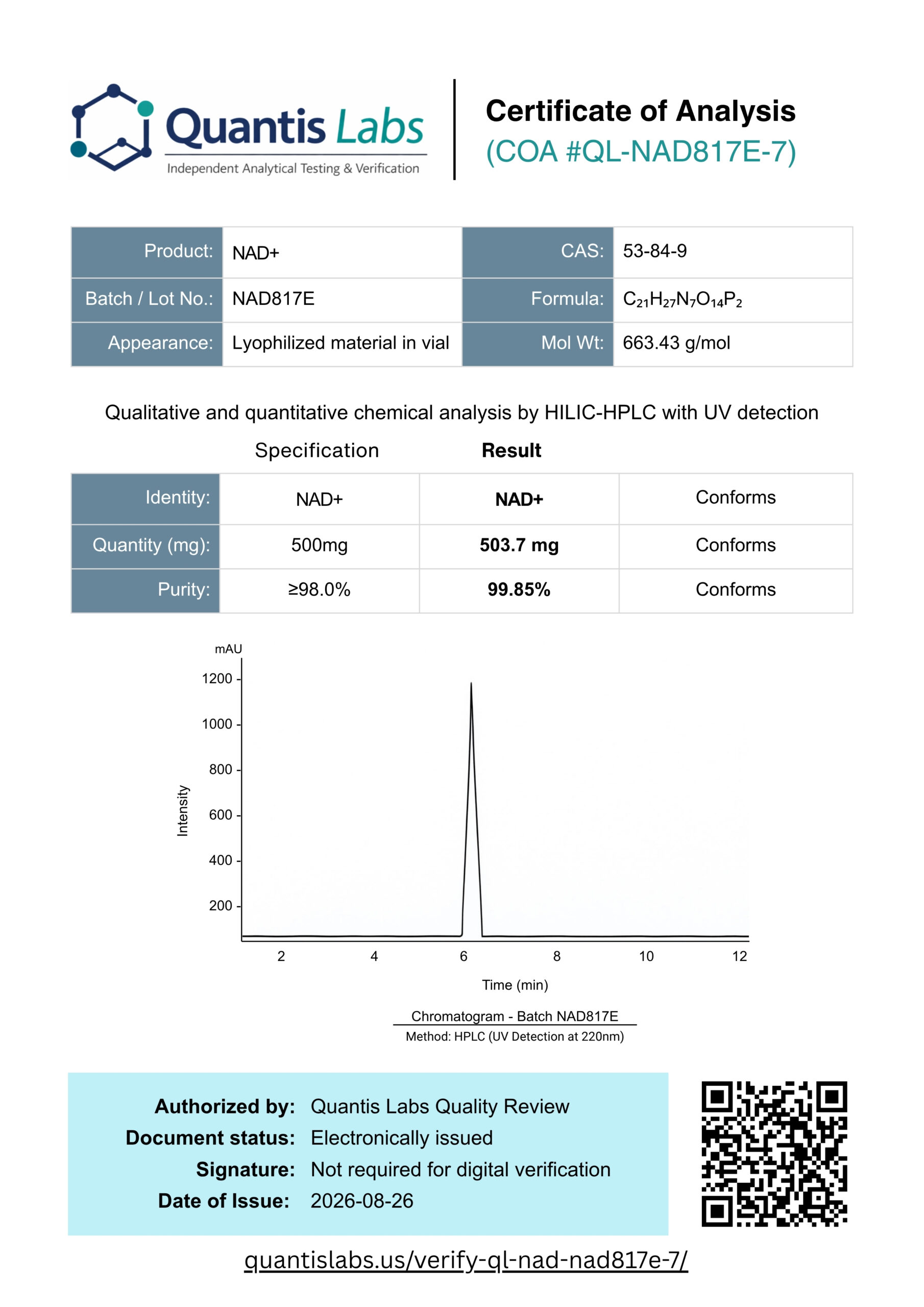
Scan to view COA
NAD+ COA QR code
Research Overview

Why researchers are interested in NAD+

NAD+ plays a central role in cellular energy production. Researchers study it because it participates in mitochondrial function, metabolic regulation, DNA repair, oxidative-stress responses, and cellular aging pathways.

01

Cellular energy

NAD+ is required for ATP production, the process cells use to create usable energy.

02

Mitochondrial function

NAD+ plays a critical role inside mitochondria, making it one of the most studied molecules in energy metabolism.

03

Healthy-aging research

Researchers frequently discuss NAD+ because cellular levels tend to decline with age.

Reference Pricing

Common NAD+ research formats in Vietnam

Pricing below is listed as Vietnam reference pricing for research-use formats. Availability, batch verification, and sourcing may vary.

NAD+

500mg vial
$30 750,000₫

NAD+

1000mg vial
$45 1,125,000₫

BAC Water

10mL vial
$5 125,000₫
Common Research Protocols

Common NAD+ research-dose discussions

NAD+ is typically discussed in milligram amounts rather than micrograms. Research conversations often focus on energy metabolism, mitochondrial support, and healthy-aging models.

Research Focus Commonly Discussed Range Notes
General metabolic research 25-50mg Often discussed for ongoing protocols.
Mitochondrial research 50-100mg Frequently discussed in energy-focused models.
Higher-dose discussions 100-250mg+ Commonly discussed in advanced protocols.
These examples represent research-community discussions only and should not be interpreted as medical guidance.
Reconstitution Examples

NAD+ calculations with BAC water

These examples use a standard U100 insulin syringe where 100 units equals 1mL. Because NAD+ is typically used in much larger milligram amounts than most peptides, 3mL and 4mL are often the most practical reconstitution options.

500mg vial + 3mL BAC water

Dose Units Approx. Vial Duration
25mg15 units20 doses
50mg30 units10 doses
100mg60 units5 doses
250mg150 units2 doses
With 3mL added to a 500mg vial, each unit equals approximately 1.67mg.

500mg vial + 4mL BAC water

Dose Units Approx. Vial Duration
25mg20 units20 doses
50mg40 units10 doses
100mg80 units5 doses
250mg200 units2 doses
With 4mL added to a 500mg vial, each unit equals 1.25mg.

1000mg vial + 3mL BAC water

Dose Units Approx. Vial Duration
25mg7.5 units40 doses
50mg15 units20 doses
100mg30 units10 doses
250mg75 units4 doses
With 3mL added to a 1000mg vial, each unit equals approximately 3.3mg.

1000mg vial + 4mL BAC water

Dose Units Approx. Vial Duration
25mg10 units40 doses
50mg20 units20 doses
100mg40 units10 doses
250mg100 units4 doses
With 4mL added to a 1000mg vial, each unit equals 2.5mg.

3mL or 4mL?

For NAD+, 4mL is often the easiest option because the syringe measurements are larger and easier to read. A 100mg dose becomes 40 units on a 1000mg vial, which many researchers find more convenient than measuring very small unit amounts.

Need different calculations?

Use the PepsVN peptide calculator to calculate any vial size, BAC water amount, dose, or syringe-unit measurement.

Mechanism

How NAD+ works inside the body

NAD+ participates in hundreds of biological reactions. Without it, cells cannot efficiently convert nutrients into usable energy. This is why it is one of the most important molecules in metabolism.

ATP production

NAD+ plays a critical role in cellular respiration, helping convert carbohydrates, fats, and proteins into ATP, the energy currency of the cell.

Mitochondrial function

Mitochondria depend heavily on NAD+ to drive energy-producing reactions. This is why NAD+ frequently appears in mitochondrial research.

DNA repair

NAD+ is required for enzymes called PARPs, which help repair damaged DNA and maintain cellular integrity.

Sirtuin activation

Sirtuins are proteins involved in cellular stress resistance and healthy-aging research. These enzymes require NAD+ to function.

Metabolic regulation

NAD+ influences glucose metabolism, fat metabolism, insulin sensitivity, and cellular stress responses.

Why aging researchers care

NAD+ levels decline with age. This decline has made NAD+ one of the most studied molecules in longevity and healthy-aging research.

Common Stacks

What researchers often discuss alongside NAD+

NAD+ is frequently discussed with compounds related to mitochondrial health, metabolism, energy production, and healthy aging.

NAD+ + MOTS-c

One of the most common pairings. Both compounds are frequently discussed in mitochondrial and metabolic research.

NAD+ + SS-31

SS-31 focuses on mitochondrial membrane function while NAD+ supports broader energy metabolism.

NAD+ + 5-Amino-1MQ

Both appear frequently in metabolism and body-composition discussions, although through different pathways.

Research Status

What researchers actually know so far

NAD+ remains one of the most extensively studied molecules in metabolism, mitochondrial biology, cellular energy production, and healthy-aging research.

Unlike many experimental peptides, NAD+ is a naturally occurring molecule found throughout the body. The question researchers are trying to answer is not whether it matters. The question is how changes in NAD+ levels affect health and performance over time.

The science is promising, but much remains under investigation, particularly regarding long-term supplementation strategies and age-related applications.

Disclaimer:

All products and information referenced on this page are intended strictly for research purposes only. NAD+ is not presented as a medical treatment, anti-aging treatment, metabolic treatment, or therapeutic recommendation. Nothing on this page is medical advice, diagnosis, treatment guidance, or a recommendation for human or animal use. The purchase, possession, sale, or use of research compounds may be restricted or illegal in some jurisdictions. Readers are responsible for complying with local laws and regulations.