```html 5-Amino-1MQ in Vietnam | Reconstitution, Research Dosing & Reference Pricing | PepsVN
5-Amino-1MQ • Vietnam • Research information

5-Amino-1MQ in Vietnam

5-Amino-1MQ is a research compound that has attracted attention for its relationship to metabolism, fat storage, energy utilization, and body composition.

Unlike GLP-1 compounds that mainly focus on appetite regulation, 5-Amino-1MQ is researched for its relationship to NNMT inhibition and metabolic pathways that may influence how the body stores and uses energy.

01
Researched for metabolism, body composition, and energy utilization.
02
Known primarily for its relationship to NNMT inhibition.
03
Frequently discussed alongside Retatrutide, Tirzepatide, and MOTS-c.
5-Amino-1MQ peptide vial
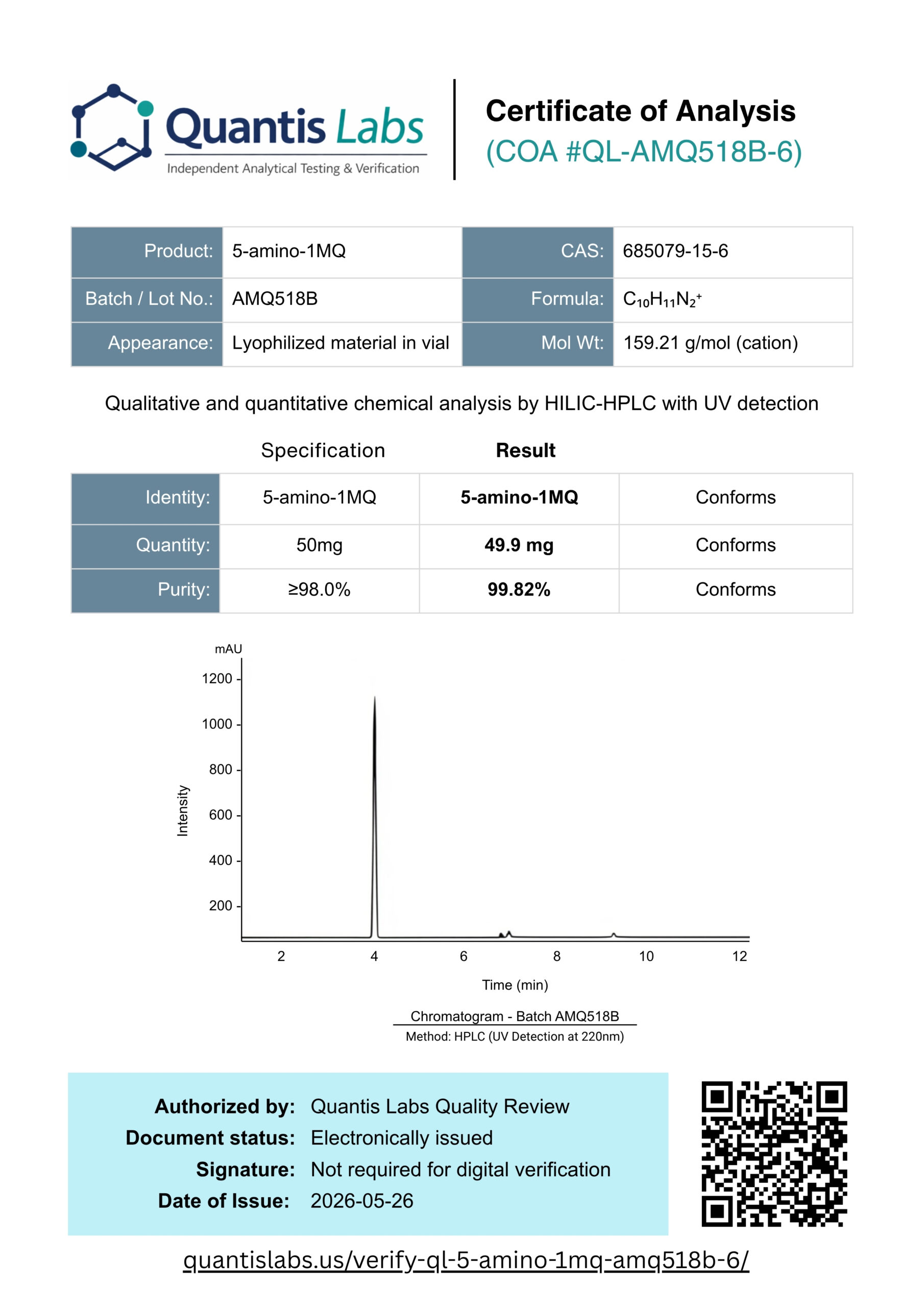
Scan to view COA
5-Amino-1MQ COA QR code
Research Overview

Why researchers are interested in 5-Amino-1MQ

5-Amino-1MQ has attracted attention because it targets a completely different pathway than GLP-1 compounds such as Semaglutide, Tirzepatide, or Retatrutide. Rather than focusing primarily on appetite regulation, researchers study 5-Amino-1MQ for its relationship to metabolism, fat storage, energy utilization, and body composition.

01

Metabolic research

Researchers study 5-Amino-1MQ because it appears to influence metabolic pathways associated with how the body stores and uses energy.

02

Body composition

Unlike appetite-focused compounds, 5-Amino-1MQ discussions often focus on body-fat regulation and metabolic efficiency.

03

NNMT inhibition

Its primary claim to fame is its relationship to an enzyme called NNMT, which researchers believe may play an important role in obesity and metabolic dysfunction.

Reference Pricing

Common 5-Amino-1MQ research formats in Vietnam

Pricing below is listed as Vietnam reference pricing for research-use formats. Availability, batch verification, and sourcing may vary.

5-Amino-1MQ

50mg vial
$25 625,000₫

BAC Water

10mL vial
$5 125,000₫
Common Research Protocols

Common 5-Amino-1MQ research discussions

Research discussions vary considerably. The examples below reflect commonly discussed ranges in research communities and are not medical recommendations.

Research Focus Commonly Discussed Range Notes
Metabolic research 1-5mg daily Often discussed as a conservative range in research communities.
Body composition research 5-10mg daily Frequently discussed in fat-loss and recomp research contexts.
Higher-dose discussions 10-20mg daily Less common, more experimental, and not something to treat casually.
These examples represent research-community discussions only and should not be interpreted as medical guidance.
Reconstitution Examples

5-Amino-1MQ calculations with 2mL or 3mL BAC water

These examples use a standard U100 insulin syringe where 100 units equals 1mL. For a 50mg vial, 2mL or 3mL is usually more practical than 1mL because small doses are easier to measure accurately.

50mg vial + 2mL BAC water

Dose Units Approx. Vial Duration
1mg4 units50 days
2mg8 units25 days
5mg20 units10 days
10mg40 units5 days
With 2mL added to a 50mg vial, each unit equals 250mcg.

50mg vial + 3mL BAC water

Dose Units Approx. Vial Duration
1mg6 units50 days
2mg12 units25 days
5mg30 units10 days
10mg60 units5 days
With 3mL added to a 50mg vial, each unit equals approximately 167mcg.

2mL or 3mL?

Both can work well. If the target amount is around 1-2mg, 3mL gives slightly larger syringe measurements. If the target amount is closer to 5-10mg, 2mL is usually more than enough and keeps the injection volume smaller.

Need different calculations?

Use the PepsVN peptide calculator to calculate any vial size, BAC water amount, dose, or syringe-unit measurement.

Oral vs Injectable

Can 5-Amino-1MQ be taken orally?

This is one of the most common questions because 5-Amino-1MQ is often seen in capsule form. Unlike many peptides, 5-Amino-1MQ is a small-molecule NNMT inhibitor, not a traditional peptide chain, so oral use is a much more realistic discussion.

Oral bioavailability

Animal data suggests 5-Amino-1MQ can be orally bioavailable, but the picture is not perfectly clean. One rat pharmacokinetic study reported oral bioavailability around 38.4%, which is fairly respectable for a research compound.

However, mouse data has been less impressive, with some researchers describing poor oral bioavailability in mice. Translation: oral absorption may depend heavily on the species, formulation, and experimental setup. Biology, as usual, refuses to keep things simple.

Why injectable formats are discussed

Injectable research formats are usually discussed because they avoid the digestive tract and may provide more predictable exposure.

Oral formats are more convenient, but convenience does not automatically mean consistent absorption. Injectable formats are less convenient, but they remove some of the guesswork around digestion and first-pass metabolism.

Oral vs injectable dosing

Oral capsule discussions often involve much larger milligram amounts than injectable discussions. That does not necessarily mean one is “stronger” than the other; it usually reflects different absorption assumptions.

If only part of an oral dose reaches circulation, the listed oral amount may need to be higher to produce comparable exposure. This is exactly why bioavailability matters and why guessing blindly is not a great research strategy.

Practical takeaway

Oral 5-Amino-1MQ may be viable, but the best-supported oral bioavailability figure comes from animal data, not large human trials.

For research pages, the honest answer is this: oral use is plausible, injectable use may be more predictable, and human-specific data is still limited.

Common Stacks

What researchers often discuss alongside 5-Amino-1MQ

Because 5-Amino-1MQ works through a completely different pathway than GLP-1 compounds, it is frequently discussed as part of broader body-composition and metabolic research protocols.

5-Amino-1MQ + Retatrutide

One of the most discussed combinations today. Retatrutide is often associated with appetite regulation and energy expenditure, while 5-Amino-1MQ is researched for metabolic efficiency and fat-storage pathways.

5-Amino-1MQ + Tirzepatide

Another popular discussion in body-composition research. The goal is often to combine appetite reduction with metabolic support through entirely different mechanisms.

5-Amino-1MQ + MOTS-c

Frequently discussed by researchers interested in mitochondrial function, cellular energy production, and metabolic adaptation. Think of it as the metabolism-nerd stack.

Mechanism

How 5-Amino-1MQ is believed to work

The entire reason 5-Amino-1MQ exists is because researchers became interested in an enzyme called NNMT. If you have never heard of NNMT before, do not worry. Neither had most people until this compound showed up.

What is NNMT?

NNMT stands for Nicotinamide N-Methyltransferase. Thankfully, researchers shortened it because nobody wants to say that five times in a conversation.

NNMT appears to play a role in energy metabolism, fat storage, and cellular energy regulation. Researchers noticed that elevated NNMT activity often appears alongside obesity and metabolic dysfunction.

That does not automatically mean NNMT causes obesity. It simply means researchers became very curious about what might happen if they reduced its activity.

How 5-Amino-1MQ affects NNMT

5-Amino-1MQ is believed to inhibit NNMT activity.

In simple English, it puts the brakes on the enzyme.

When NNMT activity is reduced, researchers have observed changes involving energy utilization, fat-cell behavior, metabolic efficiency, and cellular energy pathways.

The NAD+ connection

One reason NNMT became so interesting is its relationship to NAD+, one of the most important molecules involved in cellular energy production.

Every cell in your body relies on NAD+ to produce energy.

Researchers believe that reducing NNMT activity may help preserve NAD+ availability, potentially supporting healthier mitochondrial function and energy metabolism.

This is one of those areas where the science is fascinating, but biology has not yet signed the final agreement.

Why researchers discuss fat loss

5-Amino-1MQ does not appear to work like a GLP-1 compound.

It does not primarily reduce appetite. It does not make food less appealing. It does not convince your refrigerator to stop calling your name at midnight.

Instead, researchers are interested in whether altering NNMT activity changes how the body stores and uses energy.

That is why discussions around 5-Amino-1MQ often focus on body composition rather than hunger control.

Research Status

What researchers actually know so far

5-Amino-1MQ remains an experimental research compound. It is not approved by the FDA or other major regulatory agencies as a medication for obesity, weight loss, diabetes, or metabolic disease.

Most of the excitement comes from preclinical research and animal studies rather than large-scale human clinical trials.

Which means the science is interesting, but anyone claiming certainty is probably getting a little ahead of the evidence.

Disclaimer:

All products and information referenced on this page are intended strictly for research purposes only. 5-Amino-1MQ is an experimental research compound and is not approved for human use. Nothing on this page is medical advice, diagnosis, treatment guidance, or a recommendation for human or animal use. The purchase, possession, sale, or use of research compounds may be restricted or illegal in some jurisdictions. Readers are responsible for complying with local laws and regulations.
```