```html Epitalon in Vietnam | Reconstitution, Research Dosing & Reference Pricing | PepsVN
Epitalon • Vietnam • Research information

Epitalon in Vietnam

Epitalon, also spelled Epithalon, is a synthetic tetrapeptide commonly researched for longevity, cellular aging, telomere biology, circadian rhythm, and sleep-regulation models.

It is one of the better-known “anti-aging” research peptides, which means it attracts plenty of interest and plenty of nonsense. The useful conversation is not “will this make you immortal?” It is how researchers study telomeres, telomerase activity, and regulatory systems connected to aging biology.

01
Commonly researched for telomeres, telomerase activity, and cellular aging models.
02
Frequently discussed in longevity, circadian rhythm, and sleep-regulation research.
03
Also known as Epithalon, Epithalone, or Epitalon depending on the source.
Epitalon peptide vial
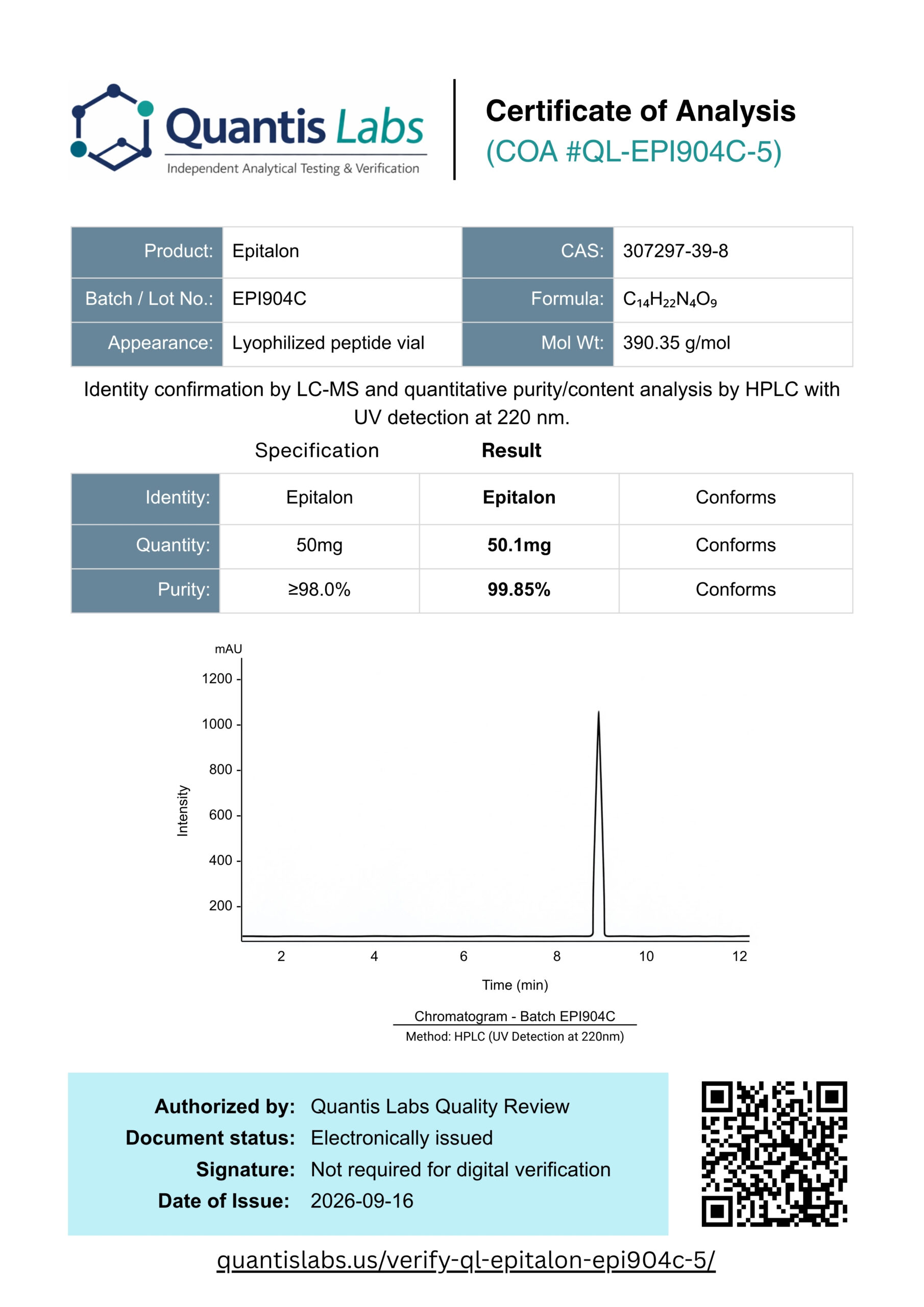
Scan to view COA
Epitalon COA QR code
Research Overview

Why researchers are interested in Epitalon

Epitalon is most often discussed in relation to aging biology. Researchers are interested in its possible relationship to telomere maintenance, telomerase activity, sleep-wake cycles, and the pineal gland.

01

Telomere research

Epitalon is frequently discussed for its relationship to telomeres, the protective caps at the ends of chromosomes.

02

Longevity models

Researchers often study Epitalon in cellular-aging and lifespan-related models, especially around DNA protection and repair signaling.

03

Sleep and circadian rhythm

Epitalon is also discussed for pineal-gland signaling, melatonin regulation, and circadian rhythm research.

Reference Pricing

Common Epitalon research formats in Vietnam

Pricing below is listed as Vietnam reference pricing for research-use formats. Availability, batch verification, and sourcing may vary.

Epitalon

10mg vial
$20 500,000₫

BAC Water

10mL vial
$5 125,000₫
Common Research Protocols

Common Epitalon research-dose discussions

Epitalon is often discussed in short-cycle research formats rather than daily year-round use. Research discussions vary widely, and the examples below are not medical recommendations.

Research Focus Commonly Discussed Range Notes
Conservative longevity research 1-2mg daily Often discussed in short-cycle research models.
Common cycle discussions 5-10mg per day Frequently discussed for brief 5-10 day research cycles.
Higher-dose discussions 10mg+ per day More aggressive and less casual. This is where “more is better” becomes a bad research philosophy.
These examples represent research-community discussions only and should not be interpreted as medical guidance.
Reconstitution Examples

Epitalon calculations with 1mL or 2mL BAC water

These examples use a standard U100 insulin syringe where 100 units equals 1mL. For a 10mg Epitalon vial, both 1mL and 2mL are practical options.

10mg vial + 1mL BAC water

Dose Units Approx. Vial Duration
1mg10 units10 doses
2mg20 units5 doses
5mg50 units2 doses
10mg100 units1 dose
With 1mL added to a 10mg vial, each unit equals 100mcg.

10mg vial + 2mL BAC water

Dose Units Approx. Vial Duration
1mg20 units10 doses
2mg40 units5 doses
5mg100 units2 doses
10mg200 units / 2mL1 dose
With 2mL added to a 10mg vial, each unit equals 50mcg.

1mL or 2mL?

For Epitalon, 1mL is usually simpler if the research dose is 1-5mg because the syringe volumes stay manageable. 2mL can be helpful for smaller doses, but larger doses may require more injection volume. Nobody wants to turn a simple peptide calculation into a swimming lesson.

Need different calculations?

Use the PepsVN peptide calculator to calculate any vial size, BAC water amount, dose, or syringe-unit measurement.

Common Stacks

What researchers often discuss alongside Epitalon

Epitalon is usually discussed in longevity, sleep, and cellular-aging research. It is often paired in conversations with compounds that target mitochondrial function, repair, skin aging, or sleep quality.

Epitalon + MOTS-c

MOTS-c is often discussed for mitochondrial and metabolic research, while Epitalon is discussed for cellular-aging and longevity models.

Epitalon + DSIP

DSIP is discussed for sleep architecture, while Epitalon is often discussed for circadian rhythm and pineal-gland research.

Epitalon + GHK-Cu

GHK-Cu is commonly discussed for skin, collagen, and repair research. Together, the conversation usually centers on aging and regeneration pathways.

Mechanism

How Epitalon is believed to work

Epitalon is one of those peptides that gets thrown into the “anti-aging” bucket, which is both understandable and dangerous. Understandable because the research is tied to aging biology. Dangerous because “anti-aging” attracts more hype than a crypto conference in 2021.

What are telomeres?

Telomeres are protective caps at the ends of chromosomes. A simple way to think about them is like the plastic tips on shoelaces. They help protect the important material from fraying.

As cells divide, telomeres tend to shorten. This shortening is one reason researchers study telomeres in aging and cellular-lifespan models.

What is telomerase?

Telomerase is an enzyme involved in maintaining telomere length.

Epitalon is often discussed because some research suggests it may influence telomerase activity. That is the main reason it became famous in longevity circles.

Why telomere research matters

Telomeres are connected to cell aging, replication limits, and genomic stability. When telomeres become too short, cells may stop dividing or enter a stressed state.

This does not mean “longer telomeres = automatic immortality.” Biology is rude like that. It means telomeres are one important piece of the aging puzzle.

Pineal gland and circadian research

Epitalon is also discussed for its relationship to the pineal gland, the small brain structure involved in melatonin production and sleep-wake timing.

Because melatonin and circadian rhythm are deeply tied to aging, recovery, and sleep quality, researchers often discuss Epitalon in this broader regulatory context.

Epitalon vs Epithalon

Epitalon, Epithalon, and Epithalone usually refer to the same peptide: Ala-Glu-Asp-Gly.

The spelling changes depending on the source, manufacturer, or translation. Peptide naming is sometimes less organized than it should be. Shocking, I know.

Why researchers discuss longevity

Epitalon is discussed in longevity research because it sits at the intersection of telomere biology, circadian rhythm, sleep regulation, and cellular aging.

It should not be treated like a guaranteed anti-aging treatment. It is better understood as a research compound used to explore some very interesting aging-related pathways.

Research Status

What researchers actually know so far

Epitalon remains an experimental research peptide and is not approved as a medical treatment for human use.

It is widely discussed in research communities because of its possible relationship to telomerase activity, telomere maintenance, circadian rhythm, and cellular-aging models.

The research is interesting, but “interesting” is not the same as “proven anti-aging miracle.” That distinction matters, even if marketing departments hate it.

Disclaimer:

All products and information referenced on this page are intended strictly for research purposes only. Epitalon is an experimental research peptide and is not presented as a medical treatment. Nothing on this page is medical advice, diagnosis, treatment guidance, or a recommendation for human or animal use. The purchase, possession, sale, or use of research compounds may be restricted or illegal in some jurisdictions. Readers are responsible for complying with local laws and regulations.
```