KLOW Blend in Vietnam
KLOW Blend is a multi-peptide research blend combining GHK-Cu, BPC-157, TB-500, and KPV. It is commonly discussed for collagen remodeling, tissue repair, skin quality, inflammation signaling, and recovery-related research models.
The formula is built around a high amount of GHK-Cu, with BPC-157, TB-500, and KPV added for broader repair and inflammation-pathway research. Basically, it is the “bring the whole repair crew” blend.
Why researchers are interested in KLOW Blend
KLOW Blend is interesting because it combines four compounds that are often discussed separately in skin, repair, collagen, wound-healing, and inflammation-related research. Instead of focusing on one narrow pathway, this blend is built around multiple repair-supporting mechanisms.
Collagen and skin research
GHK-Cu is the largest part of the formula and is commonly discussed for collagen remodeling, skin quality, wound-healing, and hair-related research.
Tissue-repair models
BPC-157 and TB-500 are frequently discussed together for soft tissue, tendon, ligament, muscle, and recovery-related models.
Inflammation signaling
KPV is commonly discussed for inflammation-related pathways, especially in skin, gut, and immune-signaling research.
What is in KLOW Blend?
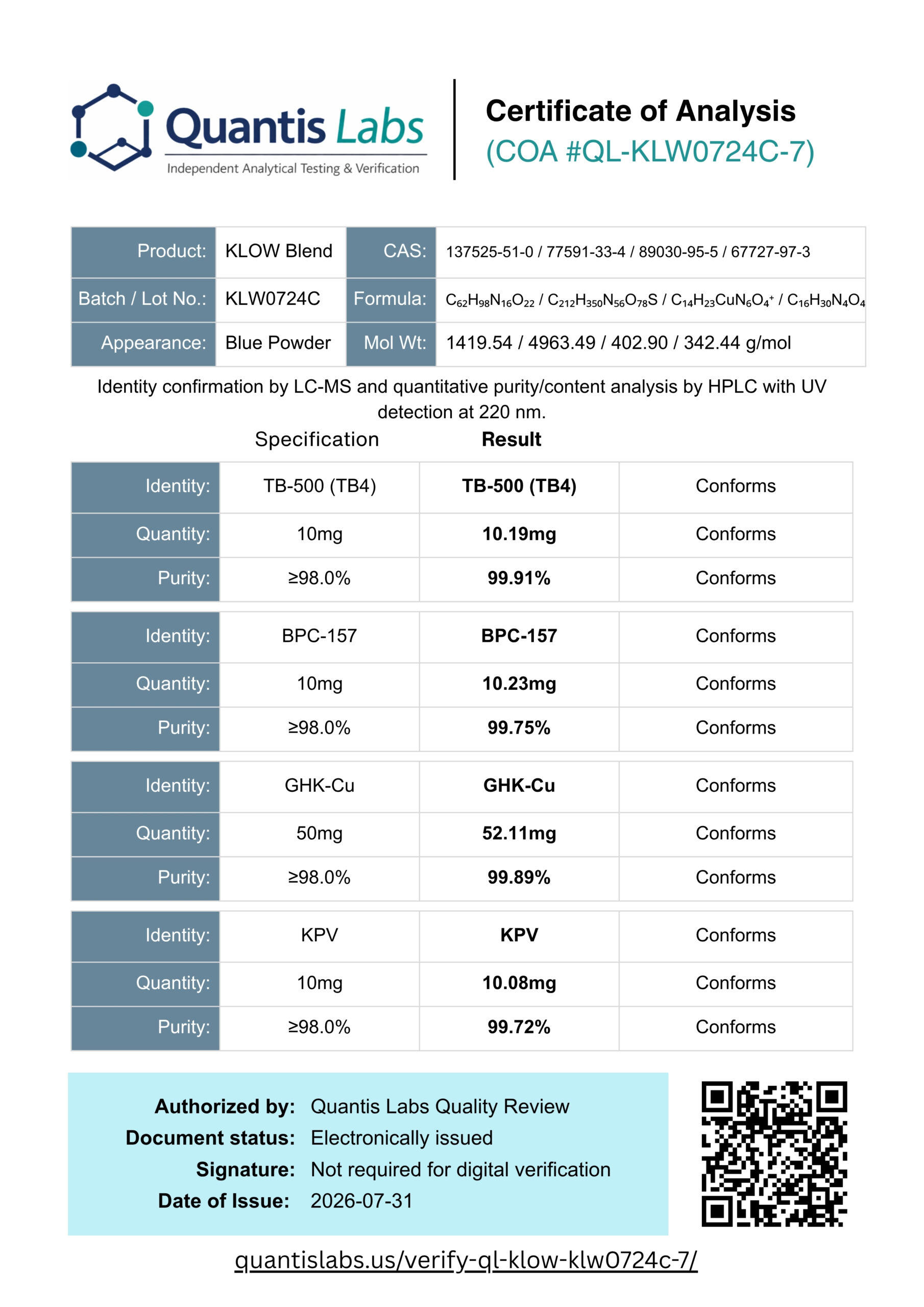
KLOW Blend contains four research compounds totaling 80mg per vial. The high GHK-Cu content makes this blend more collagen and skin-research focused than a standard BPC/TB recovery blend.
| Ingredient | Amount | Primary Research Interest |
|---|---|---|
| GHK-Cu | 50mg | Collagen, skin remodeling, wound-healing, hair/scalp research |
| BPC-157 | 10mg | Tissue repair, tendon/ligament models, recovery signaling |
| TB-500 | 10mg | Cell migration, tissue remodeling, recovery models |
| KPV | 10mg | Inflammation signaling, gut and skin research |
Common KLOW Blend research formats in Vietnam
Pricing below is listed as Vietnam reference pricing for research-use formats. Availability, batch verification, and sourcing may vary.
KLOW Blend
BAC Water
Common KLOW Blend research-dose discussions
KLOW Blend is usually discussed in total blend amounts. Because it contains multiple peptides, the amount of each ingredient depends on the total blend dose used.
| Total Blend Dose | Approx. GHK-Cu | Approx. Each Other Peptide |
|---|---|---|
| 800mcg | 500mcg | 100mcg each BPC-157 / TB-500 / KPV |
| 1.6mg | 1mg | 200mcg each BPC-157 / TB-500 / KPV |
| 4mg | 2.5mg | 500mcg each BPC-157 / TB-500 / KPV |
| 8mg | 5mg | 1mg each BPC-157 / TB-500 / KPV |
KLOW Blend calculations with 2mL or 3mL BAC water
These examples use a standard U100 insulin syringe where 100 units equals 1mL. Since KLOW Blend is 80mg total, 2mL and 3mL are the most practical examples for a standard 3mL peptide vial.
80mg vial + 2mL BAC water
| Total Blend Dose | Units | Approx. Vial Duration |
|---|---|---|
| 800mcg | 2 units | 100 doses |
| 1.6mg | 4 units | 50 doses |
| 4mg | 10 units | 20 doses |
| 8mg | 20 units | 10 doses |
80mg vial + 3mL BAC water
| Total Blend Dose | Units | Approx. Vial Duration |
|---|---|---|
| 800mcg | 3 units | 100 doses |
| 1.6mg | 6 units | 50 doses |
| 4mg | 15 units | 20 doses |
| 8mg | 30 units | 10 doses |
2mL or 3mL?
Both are practical. 2mL keeps injection volume smaller and makes 4mg equal 10 units. 3mL gives slightly larger syringe measurements, which some researchers prefer for smaller total blend amounts.
Need different calculations?
Use the PepsVN peptide calculator to calculate any vial size, BAC water amount, dose, or syringe-unit measurement.
Why these four peptides are combined
KLOW Blend is built around the idea that tissue repair, skin quality, inflammation, and recovery are not controlled by one single switch. They involve multiple overlapping pathways.
GHK-Cu: the foundation
GHK-Cu is the largest part of KLOW Blend for a reason. It is widely discussed for collagen production, extracellular matrix remodeling, skin quality, hair/scalp research, and wound-healing models.
With 50mg in the formula, GHK-Cu is clearly the star of the show. The other peptides are supporting cast members, not random passengers.
BPC-157: localized repair research
BPC-157 is commonly discussed for tendon, ligament, soft tissue, and gut-related repair models.
In KLOW Blend, BPC-157 adds a tissue-repair angle that complements the collagen and remodeling focus of GHK-Cu.
TB-500: cell migration and remodeling
TB-500 is often discussed in relation to cell migration, tissue remodeling, and recovery pathways.
Repair is not just about making new tissue. Cells also need to move, organize, and rebuild the damaged area. TB-500 is commonly discussed in that context.
KPV: inflammation-pathway support
KPV is a short peptide fragment often discussed for inflammation signaling, especially in skin, gut, and immune-related research.
In repair models, inflammation is useful at first but annoying when it overstays its welcome. KPV is included because researchers often discuss it in inflammation-regulation contexts.
What researchers often compare with KLOW Blend
Because KLOW Blend already contains several repair-focused peptides, it is usually compared with individual peptide protocols rather than stacked with many additional recovery compounds.
KLOW vs GHK-Cu alone
GHK-Cu alone is often discussed for skin and collagen research. KLOW adds BPC-157, TB-500, and KPV for broader tissue repair and inflammation-pathway discussions.
KLOW vs BPC/TB blend
A BPC/TB blend is more narrowly repair-focused. KLOW adds a much larger GHK-Cu component and KPV, making it more skin, collagen, and inflammation oriented.
KLOW + CJC/Ipamorelin
CJC/Ipamorelin is sometimes discussed alongside repair compounds because growth-hormone pulse research overlaps with recovery, sleep, and tissue-repair biology.
GHK-Cu in Vietnam
Commonly discussed for collagen, skin, and repair research.
BPC-157 in Vietnam
Frequently discussed in tissue-repair and recovery research.
TB-500 in Vietnam
Often discussed for cell migration and tissue-remodeling models.
KPV in Vietnam
Commonly discussed for inflammation, skin, and gut research.
How KLOW Blend is believed to work
KLOW Blend is not a single-pathway formula. It combines collagen remodeling, repair signaling, cell migration, and inflammation-related research into one blend. That is the whole point: repair biology is complicated, so the blend is built around more than one mechanism.
Collagen remodeling
GHK-Cu is researched for collagen formation, extracellular matrix remodeling, and skin structure. Since collagen is a major part of skin, tendons, ligaments, and connective tissue, this is central to the KLOW formula.
In plain English, GHK-Cu is there to support the rebuilding and remodeling side of the repair conversation.
Tissue-repair signaling
BPC-157 is widely discussed for soft tissue, tendon, ligament, and gut-repair models.
It adds a repair-signaling angle that pairs naturally with GHK-Cu’s collagen and matrix-remodeling focus.
Cell migration
TB-500 is commonly discussed for cell migration and tissue organization.
When tissue is damaged, cells do not just sit around waiting for instructions. They need to move into the area, coordinate repair, and help rebuild structure. TB-500 is often discussed in that context.
Inflammation balance
KPV is included because inflammation plays a major role in skin, gut, and tissue-repair models.
Inflammation is useful when repair starts, but when it hangs around too long, it becomes the biological version of a guest who will not leave. KPV is commonly discussed for that regulation side of the equation.
Skin and cosmetic research
Because KLOW contains 50mg GHK-Cu, the blend naturally leans toward skin quality, collagen, hair/scalp, and cosmetic-aging research discussions.
This is what separates it from a standard BPC/TB blend. KLOW is not just repair-focused; it is also very much a collagen and skin-remodeling blend.
Why ratios matter
The ratio matters because each total blend dose delivers much more GHK-Cu than the other peptides.
For every 800mcg total blend, the approximate breakdown is 500mcg GHK-Cu and 100mcg each of BPC-157, TB-500, and KPV. That is why the page should explain KLOW as a GHK-Cu-based repair blend, not just a random four-peptide mix.
What researchers actually know so far
KLOW Blend is a research-use peptide blend and is not presented here as a medical treatment, cosmetic treatment, wound-healing treatment, or therapeutic recommendation.
Its individual components are widely discussed in research communities for collagen remodeling, soft tissue repair, cell migration, skin health, inflammation signaling, and recovery-related models.
The blend concept is interesting, but it should still be treated as experimental. Combining several peptides does not magically remove uncertainty. It just gives researchers more pathways to think about, because apparently biology was not complicated enough already.
All products and information referenced on this page are intended strictly for research purposes only. KLOW Blend is a research peptide blend and is not presented as a medical treatment, cosmetic treatment, wound-healing treatment, or therapeutic recommendation. Nothing on this page is medical advice, diagnosis, treatment guidance, or a recommendation for human or animal use. The purchase, possession, sale, or use of research compounds may be restricted or illegal in some jurisdictions. Readers are responsible for complying with local laws and regulations.