KPV • Vietnam • Research information

KPV in Vietnam

KPV is a short peptide fragment derived from alpha-MSH that is commonly researched for inflammation signaling, gut health, skin conditions, immune regulation, and tissue-repair pathways.

While many peptides focus on growth factors, collagen, or hormone signaling, KPV is interesting because researchers often discuss it in relation to inflammation. In simple terms, it is less about building new tissue and more about helping calm down biological overreactions.

01
Commonly researched for inflammation-related pathways.
02
Frequently discussed in gut, skin, and immune-signaling research.
03
Derived from the anti-inflammatory region of alpha-MSH.
KPV peptide vial
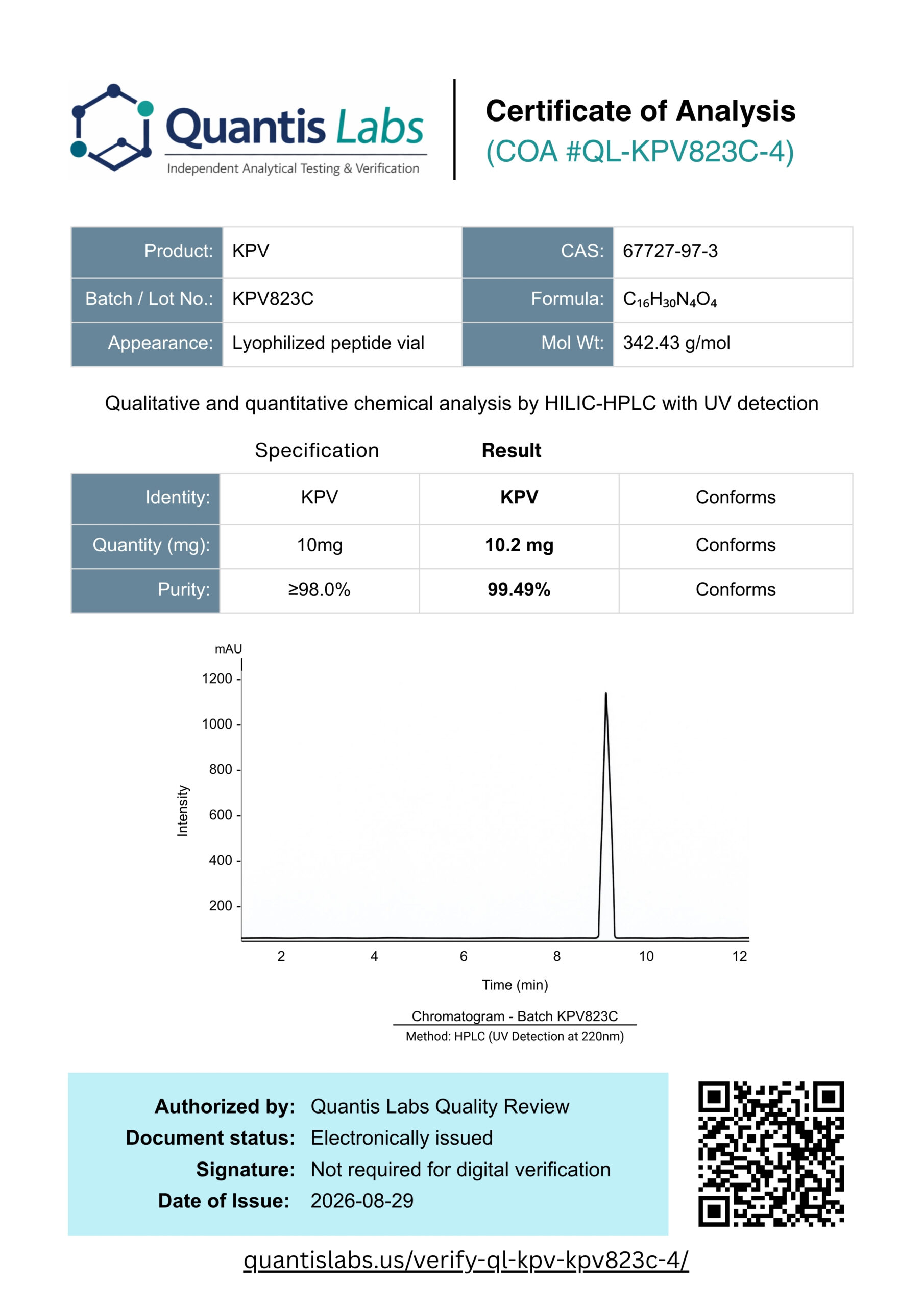
Scan to view COA
KPV COA QR code
Research Overview

Why researchers are interested in KPV

KPV has become increasingly popular because inflammation is involved in nearly every biological system. Researchers commonly discuss KPV in gut-health models, skin research, inflammatory bowel disease research, immune signaling, and tissue-repair studies.

01

Inflammation research

KPV is primarily discussed for its relationship to inflammatory signaling pathways and immune-system regulation.

02

Gut-health models

KPV frequently appears in gut-related research because inflammation plays a major role in digestive health and intestinal barrier function.

03

Skin research

Researchers often discuss KPV in skin-related models involving redness, irritation, inflammation, and barrier function.

Reference Pricing

Common KPV research formats in Vietnam

Pricing below is listed as Vietnam reference pricing for research-use formats. Availability, batch verification, and sourcing may vary.

KPV

10mg vial
$25 625,000₫

BAC Water

10mL vial
$5 125,000₫
Common Research Protocols

Common KPV research-dose discussions

KPV is commonly discussed in microgram ranges. Research discussions vary widely depending on whether the focus is gut, skin, immune, or inflammation-related pathways.

Research Focus Commonly Discussed Range Notes
Conservative research 100-200mcg Often discussed as a lower research range.
Gut and skin research 200-500mcg Frequently discussed in inflammatory pathway models.
Higher-dose discussions 500mcg-1mg More aggressive research discussions.
These examples represent research-community discussions only and should not be interpreted as medical guidance.
Reconstitution Examples

KPV calculations with 2mL or 3mL BAC water

These examples use a standard U100 insulin syringe where 100 units equals 1mL. For a 10mg vial, both 2mL and 3mL provide simple dosing calculations.

10mg vial + 2mL BAC water

Dose Units Approx. Vial Duration
100mcg2 units100 doses
250mcg5 units40 doses
500mcg10 units20 doses
1mg20 units10 doses
With 2mL added to a 10mg vial, each unit equals 50mcg.

10mg vial + 3mL BAC water

Dose Units Approx. Vial Duration
100mcg3 units100 doses
250mcg7.5 units40 doses
500mcg15 units20 doses
1mg30 units10 doses
With 3mL added to a 10mg vial, each unit equals approximately 33mcg.

2mL or 3mL?

For KPV, 2mL generally provides the cleanest math and easiest calculations. 3mL gives larger syringe measurements, which some researchers prefer when working with very small doses.

Need different calculations?

Use the PepsVN peptide calculator to calculate any vial size, BAC water amount, dose, or syringe-unit measurement.

Research Areas

Why KPV is often discussed for gut and skin research

Unlike many peptides that focus on growth factors or hormone signaling, KPV is most commonly discussed because of its relationship to inflammatory pathways.

Gut-health research

KPV frequently appears in gut-health discussions because inflammation plays a central role in intestinal barrier function and digestive health.

Researchers commonly discuss KPV in inflammatory bowel disease models and gut-barrier research.

Skin research

Skin conditions often involve excessive inflammatory signaling.

This is why KPV frequently appears in research discussions involving irritation, redness, barrier function, and inflammatory skin pathways.

Immune-system regulation

KPV is discussed because it may influence cytokines and other inflammatory signaling molecules involved in immune responses.

The goal is not eliminating inflammation completely. The goal is understanding how inflammatory signaling can be regulated without shutting down normal immune function.

Why researchers like it

Many repair-focused peptides work by encouraging growth and remodeling. KPV is interesting because it focuses more on controlling excessive inflammation.

Sometimes the fastest way to improve a situation is not adding more repair signals. It is stopping the biological argument that is already happening.

Common Stacks

What researchers often discuss alongside KPV

KPV is commonly paired with other peptides involved in tissue repair, collagen remodeling, and recovery-related pathways.

KPV + BPC-157

One of the most common pairings. BPC-157 is discussed for tissue repair while KPV is discussed for inflammation regulation.

KPV + TB-500

TB-500 is often discussed for cell migration and remodeling, while KPV adds an inflammation-focused component.

KPV + GHK-Cu

GHK-Cu is commonly discussed for collagen, skin, and wound-healing research, making it a natural companion to KPV in skin-related models.

Mechanism

How KPV is believed to work

KPV is a small peptide fragment derived from alpha-MSH (alpha-melanocyte stimulating hormone). Researchers are interested in KPV because it appears to retain some of alpha-MSH's anti-inflammatory properties while being much smaller and easier to study.

Derived from alpha-MSH

KPV stands for Lysine-Proline-Valine, three amino acids that form an active region of alpha-MSH.

Researchers believe this short fragment contains some of the anti-inflammatory activity that made alpha-MSH interesting in the first place.

Cytokine regulation

Cytokines are signaling molecules that help coordinate inflammation and immune responses.

KPV is frequently discussed because it may influence inflammatory cytokines involved in excessive immune responses.

Gut-barrier research

The intestinal barrier plays a major role in digestive health and immune regulation.

Researchers commonly investigate KPV because inflammation can disrupt barrier function and tissue integrity.

Skin signaling

Skin inflammation involves many of the same signaling pathways found elsewhere in the body.

This overlap is one reason KPV often appears in skin-related research models.

Repair versus inflammation

Many peptides focus on promoting repair. KPV focuses on reducing excessive inflammatory signaling that may interfere with repair.

Sometimes tissue recovery is not about pushing harder. It is about getting inflammation to stop yelling long enough for repair to happen.

Why researchers are excited

Because inflammation is involved in so many biological systems, a peptide that may influence inflammatory signaling has broad research potential.

That does not mean it works for everything. It simply means researchers keep finding new areas where inflammation appears to matter.

Research Status

What researchers actually know so far

KPV remains a research peptide and is not presented as a medical treatment.

It is widely discussed because of its relationship to inflammatory signaling, gut-health research, skin biology, immune-system regulation, and tissue-repair models.

The science is promising, but KPV should still be viewed as an experimental research compound rather than a proven therapeutic intervention.

Disclaimer:

All products and information referenced on this page are intended strictly for research purposes only. KPV is a research peptide and is not presented as a medical treatment, gut-health treatment, skin treatment, or therapeutic recommendation. Nothing on this page is medical advice, diagnosis, treatment guidance, or a recommendation for human or animal use. The purchase, possession, sale, or use of research compounds may be restricted or illegal in some jurisdictions. Readers are responsible for complying with local laws and regulations.