Cagrilintide in Vietnam | Reconstitution, Research Dosing & Reference Pricing | PepsVN
Cagrilintide • Vietnam • Research information

Cagrilintide in Vietnam

Cagrilintide is a long-acting amylin analog researched for appetite regulation, satiety signaling, gastric-emptying effects, and body-composition pathways.

While GLP-1 compounds get most of the attention, amylin is a separate hormone pathway that researchers are increasingly interested in. Basically, GLP-1 became famous first. Amylin was still doing useful work quietly in the background.

01
Researched for satiety, meal termination, and appetite-related signaling.
02
Designed as a long-acting analog of the hormone amylin.
03
Frequently discussed alongside Semaglutide, Tirzepatide, and Retatrutide.
Cagrilintide peptide vial
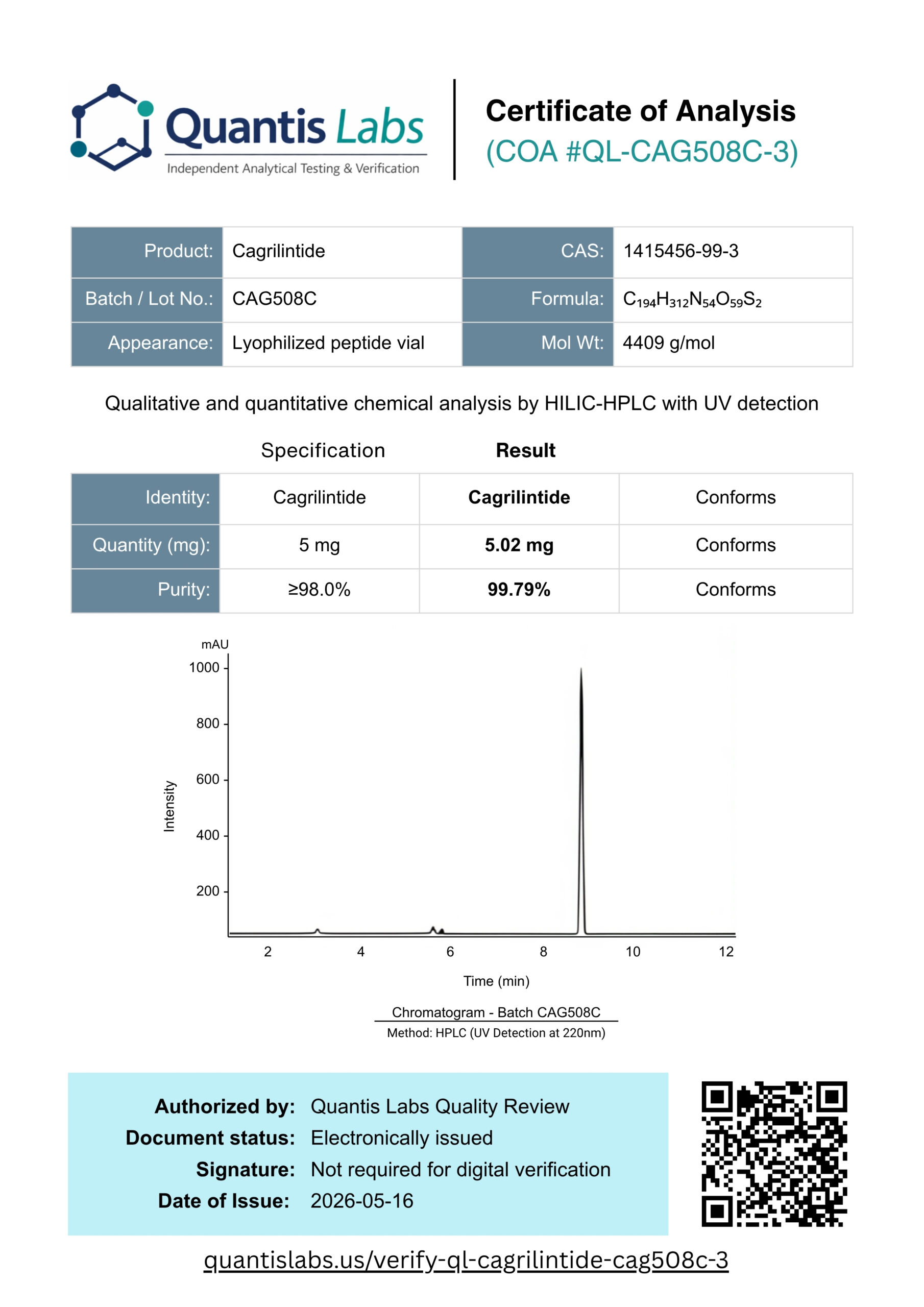
Scan to view COA
Cagrilintide COA QR code
Research Overview

Why researchers are interested in Cagrilintide

Cagrilintide became interesting because it targets the amylin pathway, which is different from GLP-1, GIP, and glucagon pathways. Researchers are especially interested in how amylin signaling may affect satiety, food intake, and body weight regulation.

01

Amylin signaling

Cagrilintide is studied as an amylin analog, meaning it is designed to mimic some of the effects of the natural hormone amylin.

02

Satiety research

Amylin is involved in meal termination signals. In plain English, it helps tell the brain when enough food has been eaten.

03

GLP-1 stacking

Because amylin and GLP-1 work through different pathways, researchers often discuss Cagrilintide alongside GLP-1-based compounds.

Reference Pricing

Common Cagrilintide research formats in Vietnam

Pricing below is listed as Vietnam reference pricing for research-use formats. Availability, batch verification, and sourcing may vary.

Cagrilintide

5mg vial
$30 750,000₫

BAC Water

10mL vial
$5 125,000₫
Common Research Protocols

Common Cagrilintide research-dose discussions

Research discussions vary widely. Cagrilintide is usually discussed in much smaller weekly amounts than many recovery peptides, so careful calculation matters.

Research Focus Commonly Discussed Range Notes
Introductory research discussions 0.3-0.6mg weekly Often discussed as a conservative starting range.
Body-composition research 1.2-2.4mg weekly Commonly discussed in appetite and satiety research contexts.
Higher-dose discussions 2.4-4.5mg weekly More aggressive research discussions. Side-effect tolerance becomes a bigger topic.
These examples represent research-community discussions only and should not be interpreted as medical guidance.
Reconstitution Examples

Cagrilintide calculations with 1mL or 2mL BAC water

These examples use a standard U100 insulin syringe where 100 units equals 1mL. For a 5mg Cagrilintide vial, both 1mL and 2mL are practical, but 2mL gives easier measurement for smaller doses.

5mg vial + 1mL BAC water

Dose Units Approx. Vial Duration
0.25mg5 units20 doses
0.5mg10 units10 doses
1mg20 units5 doses
2mg40 units2.5 doses
With 1mL added to a 5mg vial, each unit equals 50mcg.

5mg vial + 2mL BAC water

Dose Units Approx. Vial Duration
0.25mg10 units20 doses
0.5mg20 units10 doses
1mg40 units5 doses
2mg80 units2.5 doses
With 2mL added to a 5mg vial, each unit equals 25mcg.

1mL or 2mL?

For Cagrilintide, 2mL is often easier for smaller doses because the syringe measurement is larger. For example, 0.25mg is 10 units with 2mL instead of 5 units with 1mL. Tiny measurements are technically possible, but nobody enjoys squinting at a syringe like it is an eye exam.

Need different calculations?

Use the PepsVN peptide calculator to calculate any vial size, BAC water amount, dose, or syringe-unit measurement.

Common Stacks

What researchers often discuss alongside Cagrilintide

Cagrilintide is frequently discussed alongside GLP-1-based compounds because amylin and GLP-1 appear to influence appetite and satiety through different pathways.

Cagrilintide + Semaglutide

This is one of the most well-known amylin and GLP-1 research combinations. Semaglutide targets GLP-1 signaling, while Cagrilintide targets amylin signaling.

Cagrilintide + Tirzepatide

Tirzepatide targets GLP-1 and GIP pathways, while Cagrilintide adds amylin-pathway research interest. Researchers discuss this combination because the mechanisms are different.

Cagrilintide + Retatrutide

Retatrutide is discussed for GLP-1, GIP, and glucagon receptor activity. Adding Cagrilintide brings amylin signaling into the research conversation.

Mechanism

How Cagrilintide is believed to work

To understand Cagrilintide, you first need to understand amylin. GLP-1 got famous. Amylin is the quieter hormone that has been sitting in the corner saying, “I also help regulate eating, but sure, ignore me.”

What is amylin?

Amylin is a hormone released by the pancreas at the same time as insulin. Most people know insulin helps manage blood sugar after a meal. Fewer people know amylin is released alongside it.

Amylin helps regulate meal size, satiety, and how quickly food leaves the stomach. Think of insulin as helping manage nutrients after a meal, while amylin quietly tells the brain, “That is probably enough food.”

Why Cagrilintide was developed

Natural amylin does not last very long in the body. That makes it hard to study prolonged amylin signaling.

Cagrilintide was designed as a long-acting amylin analog, meaning it is built to activate amylin-related pathways for longer than natural amylin.

Satiety and meal termination

Cagrilintide is researched for its effect on satiety signaling. Satiety is not just “feeling full.” It is a coordinated message between the gut, pancreas, brain, and nervous system.

Amylin signaling appears to help tell the brain when a meal should end. Unfortunately, modern snack food was apparently designed by people who hate that signal.

Gastric emptying

Amylin can slow gastric emptying, meaning food may leave the stomach more slowly.

Slower gastric emptying can extend the feeling of fullness after eating, which is one reason Cagrilintide is discussed in appetite and body-composition research.

How it differs from GLP-1

GLP-1 compounds primarily work through GLP-1 receptor pathways. Cagrilintide works through amylin-related pathways.

Both pathways can influence appetite and food intake, but they are not the same. That is exactly why researchers are interested in combining them.

Why stacking gets discussed

Researchers became interested in whether activating GLP-1 and amylin pathways together could produce stronger appetite and weight-regulation effects than either pathway alone.

This is why Cagrilintide is often discussed with Semaglutide, Tirzepatide, and Retatrutide. Different switches, same control panel.

Research Status

What researchers actually know so far

Cagrilintide remains a research compound and is not approved as a standalone medication for human use in many markets.

It has attracted significant attention because of its relationship to amylin signaling and because amylin/GLP-1 combinations are an active area of metabolic research.

The science is promising, but anyone pretending this is all “simple and fully settled” is probably skipping a few chapters.

Disclaimer:

All products and information referenced on this page are intended strictly for research purposes only. Cagrilintide is an experimental research compound and is not presented as a medical treatment. Nothing on this page is medical advice, diagnosis, treatment guidance, or a recommendation for human or animal use. The purchase, possession, sale, or use of research compounds may be restricted or illegal in some jurisdictions. Readers are responsible for complying with local laws and regulations.
```